The dances, the band and joining in
Czech folk dances: what to expect
The Bohemian and Moravian dances behind a Prague folklore evening, the cimbalom band, what UNESCO says about verbuňk and how joining in works.
See folklore evening tickets on GetYourGuide ↗Quick answer
Expect dancers and musicians in Bohemian and Moravian costume, a cimbalom band and an invitation to learn Czech songs and dances yourself. The operator does not publish a running order, so nobody can promise which dances you will see. The traditions it draws on include Bohemian couple dances such as the sousedská, polka and furiant, and Slovácko's improvised men's verbuňk, which UNESCO lists.
Dances from the traditions behind the evening
| Dance | Region | What it is |
|---|---|---|
| Sousedská | Bohemia | Semi-slow, three-quarter time, in pairs |
| Polka | Bohemia | Quick two-four dance, 19th-century origin |
| Furiant | Bohemia | Fast, shifting accents, in pairs |
| Verbuňk | Slovácko | Improvised dance by men, UNESCO-listed |
What the operator says you will see
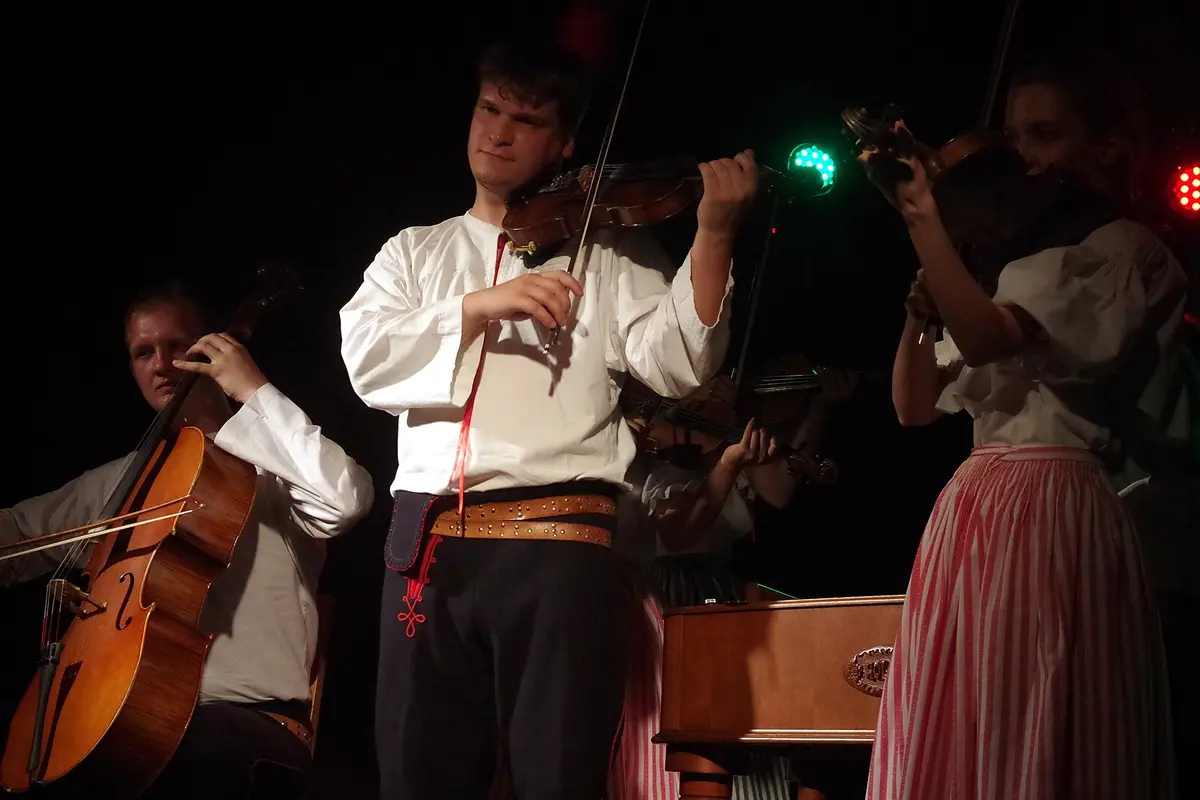
The operator describes a 2.5-hour interactive show with dancers and musicians in traditional costumes from Bohemia and Moravia. Guests learn Czech songs and dances and try playing folk instruments, and in the final part they join the cimbalom band to sing and dance to songs from their home countries. The booking adds that you can dress up in folk costumes and play games. Neither description lists the dances, so treat the sections below as background on the traditions, not a programme.
Bohemia: sousedská, polka and furiant
The sousedská is a semi-slow Bohemian dance in three-quarter time with a calm, swaying character, usually danced in a pair. Dvořák used it in his Slavonic Dances, and Josef Suk's last composition was also a sousedská. The polka began in nineteenth-century Bohemia and is in two-four time. By the 1830s it was in the ballrooms of Prague, and it then spread to Vienna, Paris and London. Its name is believed to come from the Czech word půlka, a half-step. The furiant is faster, with shifting accents that make the beat feel unpredictable, and it is danced in pairs. In Czech, furiant is also a word for a stubborn, boastful person.
Moravia and Slovácko
Moravian traditional music is known for the cimbalom, played in ensembles that also include double bass, clarinet and violins. Slovácko, also called Moravian Slovakia, is a cultural region in the south-east of the Czech Republic on the Slovak border. It is known for its folklore, music, wine and costumes, and its dialects are transitional between Czech and Slovak. Uherské Hradiště is its main centre, and Strážnice is among its other important towns. The booking describes Czech and Slovak dancing, and Slovácko is where those two traditions sit side by side.
Verbuňk, the dance UNESCO lists
UNESCO describes the Slovácko verbuňk as an improvised dance performed by boys and men in the South Moravia and Zlín districts. It has no fixed choreography, and jumping contests are part of it. It usually has three parts: a song, slow movements, then faster dancing. The name comes from the German Werbung, meaning recruitment, and reflects eighteenth-century recruiting of dancers and soldiers. UNESCO counts six regional types, with varied figures and rhythms that developed in the early twentieth century and keep changing. It was proclaimed in 2005 and inscribed on the Representative List in 2008. Folk dance groups perform it across Slovácko, mostly at festivities such as the annual Hody, and there is a contest for the best dancer at the Strážnice festival.
The cimbalom band
The cimbalom is a large trapezoidal box on legs, with strings that the player strikes with two sticks, often with cotton-wound tips. The concert version was designed in Budapest in 1874 by V. Josef Schunda, building on older folk dulcimers that were often played on a barrel or a table. Today it is played in Hungary, Slovakia, Moravia and several other countries. In Moravia it leads ensembles with violins, clarinet and double bass. The operator calls its group a cimbalom band.
Read next: The cimbalom, and the rest of a Czech folk band, explained
Why the costumes and instruments matter
UNESCO notes that the costumes and instruments used for verbuňk are handmade and need regular upkeep, so the tradition depends on financial support. It names migration from villages to cities as the greatest threat to the dance's regional types, of which it counts six. A staged evening in Prague is a performance for visitors, not a village celebration, but it does keep Bohemian and Moravian costume and music in front of an international audience, and that is part of what you are paying to see.
Joining in
Both descriptions present joining in as an invitation: learn songs and dances, try folk instruments and, in the final part, sing and dance with the band. Songs you know from home are part of that finale, so you do not need Czech. The booking lists English as its language. Nothing in either description says guests must dance, so how much you take part is up to you. If you do join, expect to be on your feet for part of the night.
What to wear
Neither the operator nor the booking sets a dress code. If you plan to try the steps, comfortable shoes are the practical choice, and everyday evening clothes will do for a dinner and show. The booking says guests can dress up in traditional folk costumes, so you do not need to bring anything special. The evening is long, so wear something you will be comfortable sitting in at a shared table.
Children, access and pets
The venue gives children small gifts and sings to birthday guests, and the booking mentions colouring books and crayons for children. Neither description sets out an age limit or says whether children dance. The booking lists the evening as not suitable for wheelchair users. Pets are not allowed. If any of these affect your group, ask the venue before you book rather than relying on a general description.
Getting there and back
The GetYourGuide booking includes a bus from a central meeting point. If you book direct, the venue's shuttle can collect you from anywhere in Prague as an extra, and the Hlubočepy tram stop is close to the door. Your confirmation shows your starting time. The show finishes late, so decide how you will get back before you go. The venue's address is Na Zlíchově 18, Praha 5 – Hlubočepy, which is what a taxi or ride-hailing driver will need. The booking guide compares the three ways in more detail.
Read next: Folklore Garden Prague: how to book
Who this isn't for
If you want a festival-level programme with named dances in a fixed order, this is not it, because the operator does not publish one. If you want to see verbuňk in its home setting, plan a trip to Slovácko in South Moravia, where it is danced at celebrations. Wheelchair users are listed as not suitable. And if joining in sounds like a chore, a seated concert will suit you better than an interactive evening.
Frequently asked questions
Do I have to dance?
No. Both the operator and the booking present joining in as an invitation, and nothing says guests must take part. You can learn songs and dances, try folk instruments, or simply watch the dancers and the band.
What is verbuňk?
An improvised dance by boys and men in South Moravia and Zlín districts, with no fixed choreography and jumping contests. UNESCO proclaimed it in 2005 and inscribed it on its Representative List in 2008. The operator does not say whether this evening includes it.
Which instruments will I hear?
The operator calls its group a cimbalom band. Moravian ensembles of this kind usually combine the cimbalom with violins, clarinet and double bass. Guests can also try folk instruments during the show.
Will I see the sousedská, polka and furiant?
Possibly, but the operator does not publish its programme. They are Bohemian dances, and the show draws on Bohemian and Moravian traditions, so they are a reasonable guide to the style rather than a promise.
Is the show in English?
The booking lists English as its language. The songs and dances are Czech, and in the final part guests sing songs familiar from their own countries, so no Czech is needed to take part.
Can children join in?
The venue gives children small gifts and the booking mentions colouring books and crayons. Neither sets an age limit or says whether children dance, so ask the venue if you are unsure.
Sources